
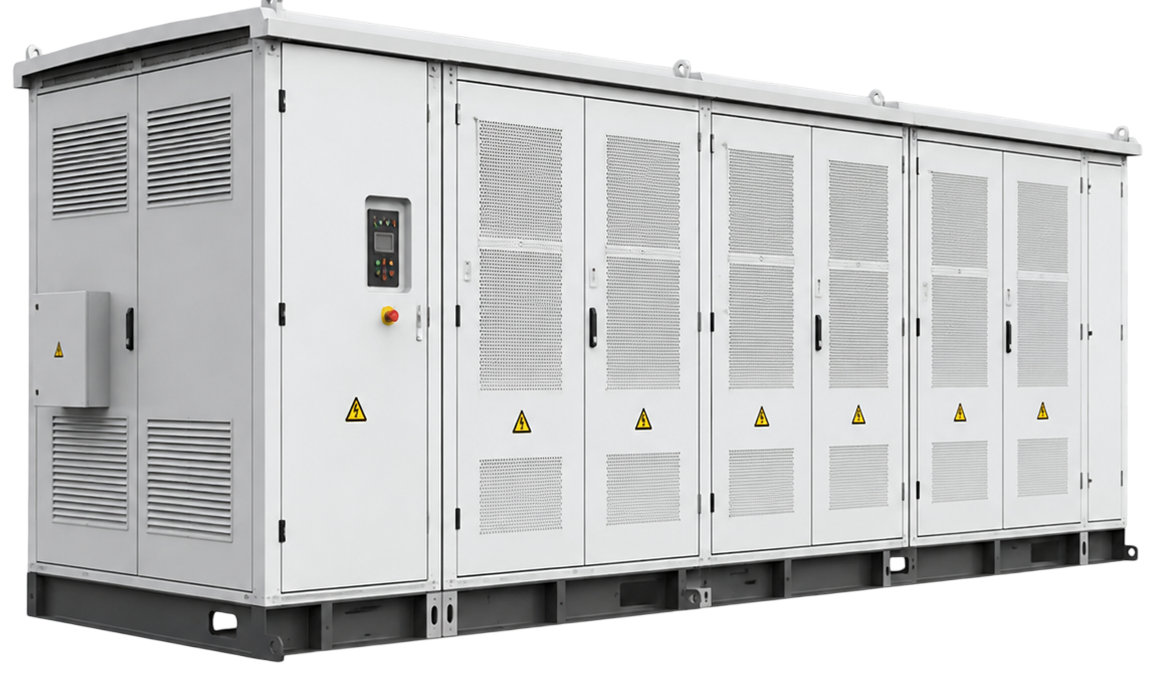
Energy storage systems for energy facilities are used in projects where it is important to improve power supply stability, use stored energy during load periods and integrate battery systems with generation or the facility’s engineering infrastructure.
For energy facilities, ESS can operate as a buffer system, backup power source or part of a hybrid scheme with the grid, solar generation, diesel generator or another energy source.
The solution is selected by required power, energy reserve, autonomous operating time, charge and discharge mode, placement conditions, temperature range and monitoring requirements.
ESS for renewables are used with solar or other distributed generation. A battery system helps store energy during generation periods and use it later — when load changes, generation decreases or backup power is required.
For such projects, battery module service life, BMS operation, compatibility with inverter equipment, temperature conditions and the ability to scale the system by power and capacity are important.
What is considered during design
| Parameter | What is important |
|---|---|
| Generation type | Solar, hybrid or other distributed generation |
| Required capacity | Amount of energy to be stored |
| System power | Facility load and operating mode |
| Inverter / external equipment | Compatibility and connection scheme |
| BMS | Control, protection, balancing, monitoring |
| Temperature range | Placement and operating conditions |
| Scalability | Ability to increase system capacity |
| Execution format | Modular, cabinet or containerized solution |
A buffer energy storage system is used to smooth consumption patterns and temporarily store energy. Such a solution may be used at facilities where load changes during the day, engineering infrastructure requires support or power supply stability must be improved.
A buffer system may include ZUBR ES battery modules, BMS, communication interfaces, protective switching equipment and cabinet or containerized execution.
Possible tasks
| Task | How ESS helps |
|---|---|
| Load smoothing | Energy storage and output at the required moment |
| Operation with generation | Use of energy during changes in generation output |
| Facility support | Additional energy source for engineering systems |
| Scalability | Ability to select capacity according to facility parameters |
Energy storage systems can be used in hybrid power supply schemes: together with the grid, solar generation, diesel generator or another energy source.
Such solutions are relevant for facilities where backup power, reduced dependence on an unstable grid, support for critical loads or autonomous operation of equipment for a specified time are important.
What is defined in the project
| Parameter | What is defined |
|---|---|
| Operating scenario | Backup, hybrid operation, autonomous mode |
| Autonomy time | How long the system must support the load |
| Critical loads | Equipment that must receive power first |
| Connection scheme | Grid, inverter, generator, solar generation |
| Monitoring | Control of battery status and system parameters |
| Placement format | Cabinet, container, technical room or custom execution |
An ESS is selected not only by battery capacity. Correct solution selection requires considering the facility purpose, load power, autonomous operating time, charge and discharge mode, placement conditions, safety requirements and method of integration with external equipment.
| Selection criterion | What to consider |
|---|---|
| Purpose | Energy sector, industry, private home, remote site |
| Execution format | Modular, cabinet-type, containerized or home solution |
| Operating scenario | Backup, buffer, operation with renewables, hybrid scheme, autonomy |
| Load power | Peak and continuous power of consumers |
| Capacity | Required energy reserve |
| Autonomy time | How long the system must support the load |
| Voltage | Facility and equipment requirements |
| Chemical system | Li-Ion / LFP — according to safety, service-life and operating-mode requirements |
| BMS | Protection, balancing, monitoring and data exchange |
| Temperature range | Operating and placement conditions |
| Interfaces | CAN / RS485 / telemetry — if required |
| Scalability | Ability to increase system capacity and power |
| Placement | Rack, cabinet, container, technical room or project execution |
For energy facilities, operation with generation, buffer modes and integration with external infrastructure are usually important. For industry, backup power, controllability, safety and adaptation to the enterprise operating mode are essential. For containerized ESS, power, capacity, climate control, safety and placement conditions matter. For private homes, autonomy, safe operation, compatibility with solar generation and support of critical loads are important.
For consultation on selecting ESS for different applications, please contact info@1ak-group.com